Rising advertising costs are a challenge for businesses of all sizes. While cutting ad spend may seem risky, it is possible to reduce costs without sacrificing conversions—if you focus on smarter optimization rather than fewer ads. This guide explains proven strategies to lower your ad spend while maintaining (or even improving) conversion performance.
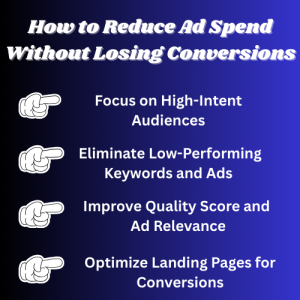
1. Focus on High-Intent Audiences
Not all traffic converts equally. One of the biggest budget drains is targeting users who are unlikely to take action.
Use remarketing to target users who have already visited your website.
Narrow your audience based on location, age, device, and interests.
Exclude irrelevant audiences and placements that don’t perform.
By targeting people closer to conversion, you spend less and gain more value.
2. Eliminate Low-Performing Keywords and Ads
Regular campaign audits are essential to controlling costs.
Pause keywords with high spend but low or zero conversions.
Add negative keywords to prevent your ads from showing for irrelevant searches.
Remove ads with low CTR and poor Quality Scores.
This helps ensure every click you pay for has a higher chance of converting.
3. Improve Quality Score and Ad Relevance
Platforms like Google Ads reward relevant, high-quality ads with lower CPCs.
Match ad copy closely with your target keywords.
Use clear headlines and strong calls-to-action.
Ensure your landing page content aligns with the ad message.
A higher Quality Score means you pay less per click while maintaining visibility.
4. Optimize Landing Pages for Conversions
Driving traffic is useless if your landing page doesn’t convert.
Improve page speed and mobile responsiveness.
Use simple forms and clear CTAs.
Remove distractions and focus on one primary goal.
Even small improvements in conversion rate can significantly reduce overall ad costs.
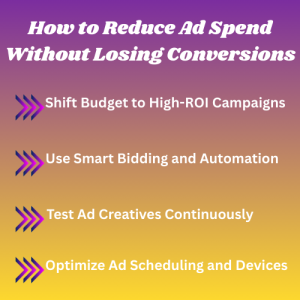
5. Shift Budget to High-ROI Campaigns
Instead of spreading your budget evenly, invest more in what works.
Identify campaigns, ad groups, and keywords with the highest ROI.
Reduce or pause spending on low-performing campaigns.
Scale only the ads that consistently deliver conversions.
This approach maximizes results without increasing total spend.
6. Use Smart Bidding and Automation
Most ad platforms offer automated bidding strategies designed to optimize performance.
Use Target CPA or Maximize Conversions bidding.
Let algorithms adjust bids based on device, time, and user behavior.
Combine automation with manual monitoring for best results.
Smart bidding often reduces wasted spend while maintaining conversion volume.
7. Test Ad Creatives Continuously
Ad fatigue increases costs and lowers conversions.
Rotate multiple ad creatives to avoid overexposure.
Test different headlines, descriptions, visuals, and CTAs.
Pause underperforming ads and scale winning variations.
Better-performing ads reduce CPC and improve conversion rates.
8. Optimize Ad Scheduling and Devices
Ads don’t perform equally at all times or on all devices.
Analyze performance by time of day and day of week.
Reduce spend during low-converting hours.
Adjust bids for devices that deliver better ROI.
These refinements help cut unnecessary spend without impacting results.
9. Track and Measure the Right Metrics
Focusing only on clicks can lead to wasted budget.
Track cost per conversion, not just CPC.
Use conversion tracking and analytics tools.
Monitor lifetime value (LTV) instead of single conversions.
Reducing ad spend doesn’t mean reducing results. By refining targeting, improving ad relevance, optimizing landing pages, and reallocating budget to high-performing campaigns, you can lower costs while maintaining conversions. The key is continuous testing, analysis, and optimization.
When done strategically, smarter advertising—not bigger budgets—drives sustainable growth.