Content Marketing Funnel Explained: A Step-by-Step Guide
In today’s digital world, customers don’t buy instantly. They move through a journey—from discovering your brand to finally becoming loyal customers. This journey is known as the content marketing funnel. Understanding this funnel helps businesses create the right content for the right audience at the right time.
Let’s break down the content marketing funnel and how it works.
What Is a Content Marketing Funnel?
A content marketing funnel is a structured path that guides potential customers through different stages of awareness and decision-making using targeted content. Instead of pushing sales directly, you educate, engage, and build trust—leading prospects naturally toward conversion.
The funnel is divided into three main stages:
Top of the Funnel (TOFU) – Awareness
Middle of the Funnel (MOFU) – Consideration
Bottom of the Funnel (BOFU) – Conversion
Each stage needs different types of content.
1. Top of the Funnel (TOFU) – Awareness Stage
At this stage, people don’t know your brand yet—or even that they have a problem. Your goal is to attract attention and educate without selling.
Goal:
Build brand awareness
Drive traffic
Create interest
Best Content Types:
Blog posts
Social media content
Infographics
Videos
SEO articles
Free guides
Example:
A person searching “How to grow my business online” may find your blog on digital marketing tips. They now know your brand exists.
Tip: Focus on solving problems, not selling.
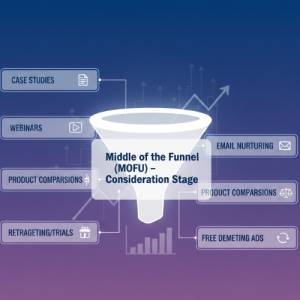
2. Middle of the Funnel (MOFU) – Consideration Stage
Here, your audience understands their problem and is looking for solutions. Now your content should build trust and position your brand as the best option.
Goal:
Educate deeper
Build relationships
Capture leads
Best Content Types:
Case studies
Email newsletters
Webinars
E-books
Comparison guides
Lead magnets
Example:
After reading your blog, the user downloads your free e-book on “Digital Marketing Strategies.” Now they’re a lead, and you can nurture them with emails.
Tip: Show how your product or service solves their problem.
3. Bottom of the Funnel (BOFU) – Conversion Stage
This is where the buying decision happens. Your audience trusts you and is ready to choose. Your content should remove doubts and encourage action.
Goal:
Convert leads into customers
Increase sales
Best Content Types:
Product demos
Free trials
Testimonials
Reviews
Sales pages
Limited-time offers
Example:
A lead receives an email with a free trial offer and a customer success story. This motivates them to purchase.
Tip: Use strong calls-to-action (CTA).
Why the Content Marketing Funnel Matters
Helps target the right audience
Improves conversion rates
Builds long-term relationships
Saves marketing cost
Creates brand authority
Instead of chasing random traffic, the funnel ensures you attract, nurture, and convert the right people.
How to Build Your Own Content Marketing Funnel
Know Your Audience – Understand their pain points.
Map Content to Each Stage – Create TOFU, MOFU, and BOFU content.
Use Lead Capture Tools – Forms, email sign-ups, free downloads.
Nurture with Email Marketing – Send value-based content.
Optimize and Track – Measure performance and improve.
Final Thoughts
The content marketing funnel is not about pushing sales—it’s about guiding customers with value-driven content. When done correctly, it builds trust, loyalty, and consistent conversions.
If you want long-term growth, start creating content for every stage of the funnel today.